
Phase 1 businesses have until 31 July 2026 to appoint an Accredited Service Provider. That deadline is closer than most finance teams realise, especially for companies still treating e-invoicing as a 2027 implementation issue.
I am not looking at this as a technical update or a legal summary. I am looking at it as a finance operations change that will affect invoicing, collections, vendor processing, VAT controls, ERP configuration and audit readiness.
The question for CFOs and finance managers is not simply, "What does the law say?" The better question is, "What must my finance function be able to do before the system goes live?"
What Is UAE E-Invoicing - and Why It Is Different This Time
UAE e-invoicing is not a PDF-via-email upgrade. It is a structural change to the invoice-to-cash and purchase-to-pay cycle.
The UAE has adopted a fully standardised, machine-readable format called PINT-AE, based on Peppol. Invoices will be exchanged through government-accredited intermediaries rather than simply being created, attached and emailed between businesses.
That matters because the FTA will receive near-real-time transaction data. Once that visibility exists, audit risk changes permanently. VAT treatment, TRN quality, invoice fields, credit notes and transaction classification will no longer be buried in periodic reporting cycles.
An e-invoice is not a PDF. It is structured XML data in PINT-AE format, exchanged through an Accredited Service Provider over the OpenPeppol network, with tax data reported to the FTA simultaneously.
How the System Actually Works - The DCTCE 5-Corner Model
The UAE model is called Decentralized Continuous Transaction Control and Exchange, or DCTCE. The name sounds technical, but the operating logic is straightforward: businesses exchange the commercial invoice through accredited service providers, while tax-relevant data is reported to the FTA in real time.
Here is the practical flow:
- Corner 1 - Supplier generates invoice in their ERP or billing system
- Corner 2 - Supplier's ASP validates the data, converts to PINT-AE XML and certifies sender identity
- Corner 3 - Invoice is transmitted over the OpenPeppol network from supplier's ASP to buyer's ASP
- Corner 4 - Buyer's ASP delivers the validated invoice into the buyer's accounting system
- Corner 5 - Supplier's ASP simultaneously sends tax data to the FTA in real time
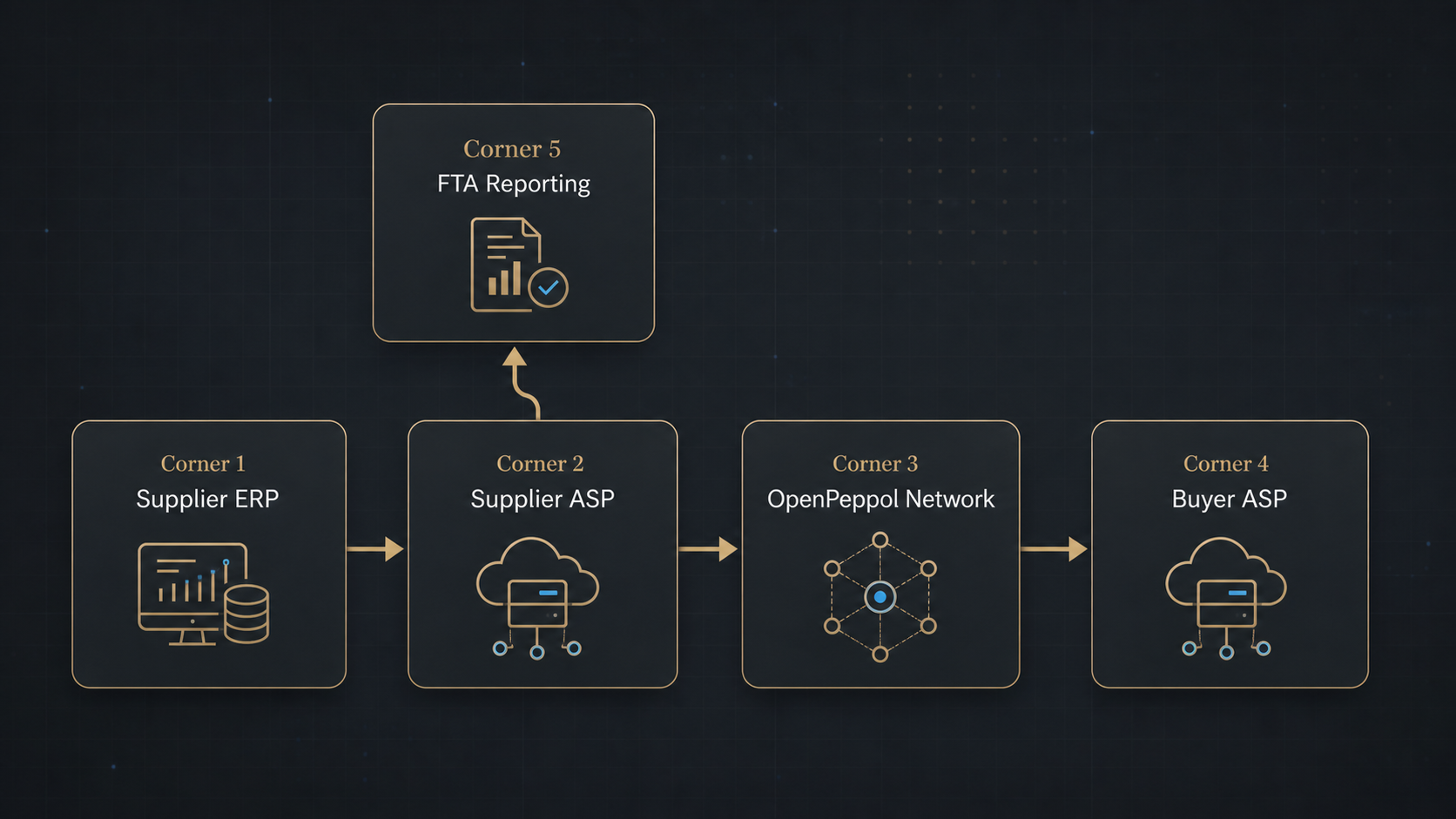
The decentralised structure matters because the commercial invoice stays in the business network. The supplier and buyer exchange the invoice through their respective ASPs, while the FTA receives tax-relevant fields from the supplier's ASP.
This is different from a fully centralised clearance model. In Saudi Arabia's ZATCA model, for example, the tax authority plays a much more central role in clearance and reporting. The UAE's model keeps the business exchange decentralised through OpenPeppol while still giving the FTA continuous transaction-control visibility.
For finance teams, the distinction is important. You are not just submitting data to government. You are redesigning how invoice data moves between your ERP, your ASP, your customer, your customer's ASP and the FTA.
Who Must Comply
In plain language, businesses conducting B2B and B2G transactions in the UAE fall within the scope of e-invoicing. VAT-registered entities specifically must issue invoices electronically through Accredited Service Providers.
B2C transactions are currently outside the mandatory DCTCE scope, although normal VAT invoicing rules still apply. Exclusions also include sovereign government services, airline electronic tickets and certain exempt or zero-rated financial services, subject to FTA confirmation.
One point I would not ignore: even non-VAT-registered businesses conducting B2B transactions fall within scope. Do not assume that no VAT registration means no e-invoicing impact.
| Transaction Type | In Scope | Notes |
|---|---|---|
| B2B - domestic | Yes | Mandatory per phase dates |
| B2G - federal and emirate | Yes | Government entities go-live July 2027 |
| B2C | No | Standard VAT invoicing rules still apply |
| Sovereign government services | No | Excluded |
| Airline electronic tickets | No | Excluded |
| Certain exempt/zero-rated financial services | No | Subject to FTA confirmation |
The Phased Rollout - Deadlines You Cannot Miss
| Phase | Who | ASP Appointment Deadline | Mandatory Go-Live |
|---|---|---|---|
| Pilot / Voluntary | Selected taxpayers and early adopters | N/A | 1 July 2026 |
| Phase 1 | Businesses with revenue >= AED 50 million | 31 July 2026 | 1 January 2027 |
| Phase 2 | Businesses with revenue < AED 50 million | 31 March 2027 | 1 July 2027 |
| Government entities | All federal and emirate government bodies | TBC | 1 July 2027 |
If you are a Phase 1 business, the ASP appointment deadline of 31 July 2026 is the one that should be on your radar right now - not the January 2027 go-live. Integration and testing between your ERP and an ASP typically takes 3 to 6 months. The window is narrowing.
The ASP Requirement - What It Means in Practice
Businesses cannot connect directly to the central platform. They must work through an FTA-accredited intermediary. The ASP validates invoice data, converts it into PINT-AE XML, transmits it over the OpenPeppol network, reports tax data to the FTA in real time and supports archiving of e-invoice records.
From experience, the ASP selection decision is not just a technical one. It is a commercial and operational decision. A low-cost provider with weak rejection handling can create cash collection issues. A technically strong provider that does not integrate well with your ERP can create manual workarounds and control gaps.
Finance teams should evaluate ASPs on integration capability with existing ERP systems, service levels for invoice rejection handling, pricing model, whether per-invoice or flat fee, and track record with the FTA accreditation process.
Penalties for Non-Compliance
Cabinet Decision No. 106 of 2025
Penalty exposure starts with process failure.
The FTA has signaled that penalty enforcement will align with go-live dates - but businesses that have not started their ASP onboarding process by mid-2026 are taking a compliance risk they do not need to take.
What This Means for Finance Operations
This is not just a technology project. The invoice-to-cash cycle will change because real-time validation means rejected invoices need exception workflows. Finance teams need to design these before go-live, not after.
FTA audit risk is permanently elevated from 2027 onwards. The FTA will have transaction-level data in near-real time. Businesses with inconsistent VAT treatment, mismatched TRNs or poor invoice data quality will be visible immediately.
ERP readiness is the hidden problem. Most mid-market ERPs in the UAE - including older Odoo, Sage and Microsoft Dynamics implementations - will need configuration work or middleware to produce PINT-AE compliant output. This is not a toggle switch.
The opportunity is also real. Businesses that invest now in clean data, structured processes and a well-integrated ASP will enter 2027 with an audit-ready finance function. That is a competitive advantage, not just a compliance checkbox.
Action Checklist for Finance Teams
E-invoicing is the UAE's most significant shift in tax infrastructure since VAT was introduced in 2018. The businesses that treat it as a technology project will struggle. The ones that treat it as a finance transformation will come out ahead.
Umer Nawaz FCCA
Chartered Accountant with expertise in UAE VAT, Corporate Tax and AI-augmented Finance | LinkedIn: /omernawaz