
Most finance teams working through month-end right now do not realise they are producing 2026 comparative data that will need to comply with a new presentation standard from January 2027.
IFRS 18 is not a disclosure tweak. It replaces IAS 1 entirely and restructures the income statement. The window to prepare is 2026 - and it is already running.
If you are a CFO, Group Finance Director or finance manager, the practical question is not whether IFRS 18 applies. The question is whether your systems, reporting packs and comparatives will be ready before audit pressure arrives.
What Is IFRS 18 and Why Does It Matter
IFRS 18 replaces IAS 1, Presentation of Financial Statements, for annual reporting periods beginning on or after 1 January 2027. The IASB issued the standard in April 2024, and earlier adoption is permitted.
This is the most significant overhaul of income statement presentation in two decades. It applies to all entities reporting under IFRS - listed companies, subsidiaries and entities preparing IFRS-compliant financial statements in the UAE and globally.
The reason it matters is simple: IFRS 18 changes how performance is presented. It affects the income statement structure, the way management performance measures are disclosed and the classification of certain cash flow items. That reaches directly into your ERP, chart of accounts, reporting packs and board narratives.
IFRS 18 is mandatory for annual reporting periods beginning on or after 1 January 2027. Comparative periods - meaning your 2026 financials - must be restated. Most organizations need to start now.
What Actually Changes - The Core Reforms
Change 1 - New Mandatory Subtotals in the Income Statement
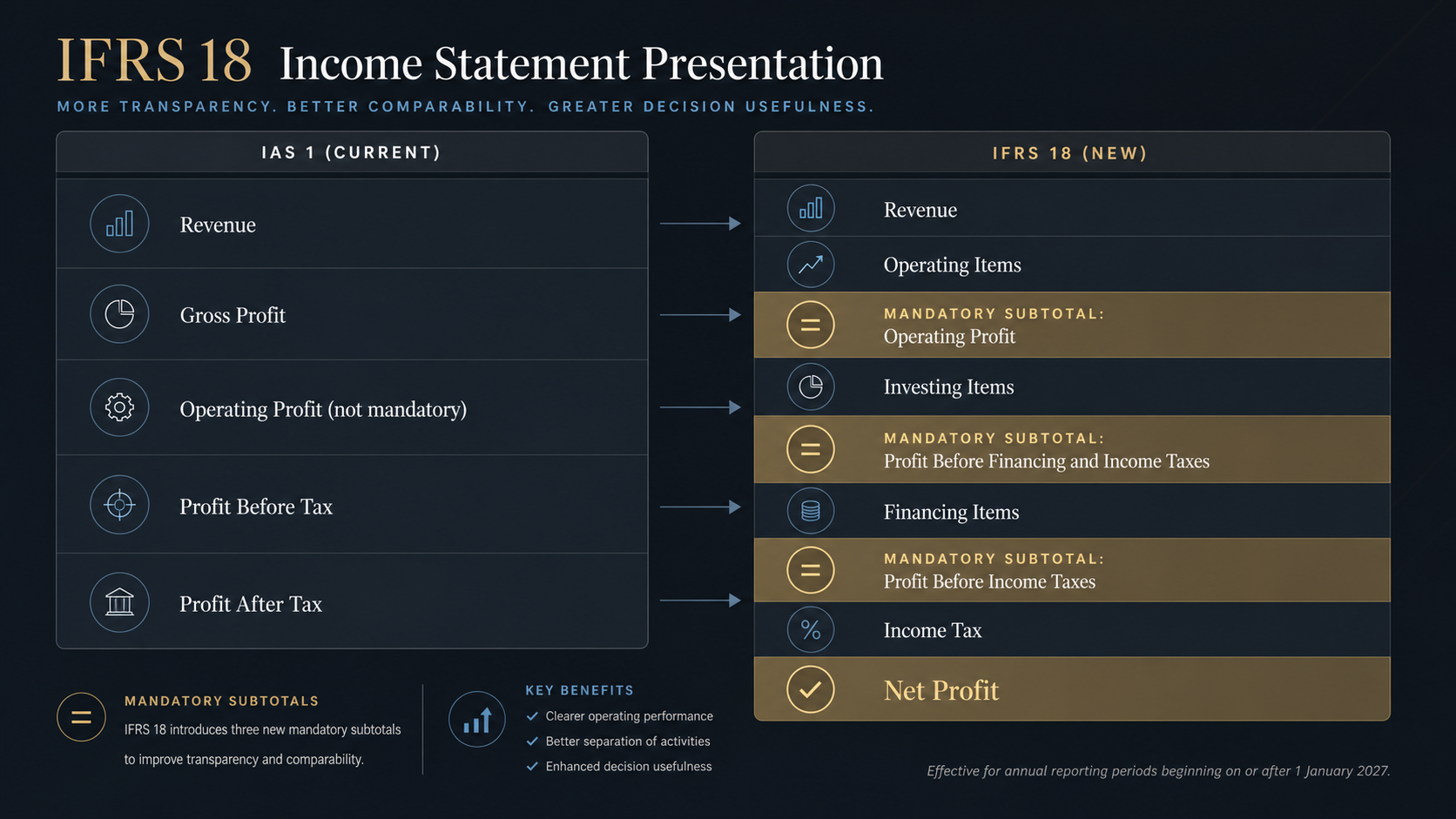
Under IFRS 18, operating profit becomes a defined and mandatory subtotal. That is a major shift. Entities can no longer rely on a loosely defined operating result or present an adjusted operating profit without making the gap from the IFRS 18 subtotal visible.
The income statement now has a prescribed structure built around operating, investing and financing categories. Income and expenses need to be classified into the right category, and those classifications will drive the mandatory subtotals that users of the financial statements see first.
This matters for companies with diverse income streams. Treasury income, investment returns, foreign exchange movements, inter-company charges, financing costs and other recurring items may not sit where management has historically presented them. The story of performance may look different even if the underlying economics have not changed.
For finance teams, this is not only a disclosure exercise. It requires a proper mapping between the chart of accounts, management reporting and IFRS 18 categories. If that mapping is left until the audit file stage, the process will become painful.
Change 2 - Management Performance Measures
This is the part of IFRS 18 that many CFOs are underestimating. If you disclose a non-GAAP or alternative performance measure in your financial statements - EBITDA, adjusted profit, underlying earnings, cash profit or similar measures - IFRS 18 now requires discipline around it.
This is the part of IFRS 18 that will cause the most friction in practice. Investor relations teams have spent years crafting adjusted profit narratives. IFRS 18 does not ban them - but it requires the gap between the adjusted number and the GAAP number to be visible and explained in the financial statements themselves. That is a significant change.
Change 3 - Statement of Cash Flows: Classifying Interest and Dividends
IAS 7 previously gave entities choices on where to classify interest paid, interest received and dividends received in the statement of cash flows. IFRS 18 removes that choice for most entities and mandates specific classification.
This will change cash flow presentation for many businesses, particularly those that have historically classified interest received as operating cash flow. It is a shorter technical change than the income statement reforms, but operationally it still needs ERP configuration, report mapping and comparative restatement discipline.
What Stays the Same
Not everything changes. The balance sheet structure does not change in the same way the income statement does. The notes disclosure framework is largely retained, although some presentation and grouping requirements are restructured.
Going concern and basis of preparation requirements are also unchanged. That is important because IFRS 18 is not a complete rewrite of financial reporting. It is a targeted, but very significant, change to performance presentation and related disclosures.
The 2026 Comparative Problem - Why You Need to Start Now
IFRS 18 requires full retrospective application. That means your 2027 financial statements must include restated 2026 comparatives.
To produce those comparatives, you need to know how your 2026 income and expenses will be classified under the new three-category structure. You also need your ERP capturing data at the right granularity to support the mandatory subtotals, and you need to identify all Management Performance Measures currently in use.
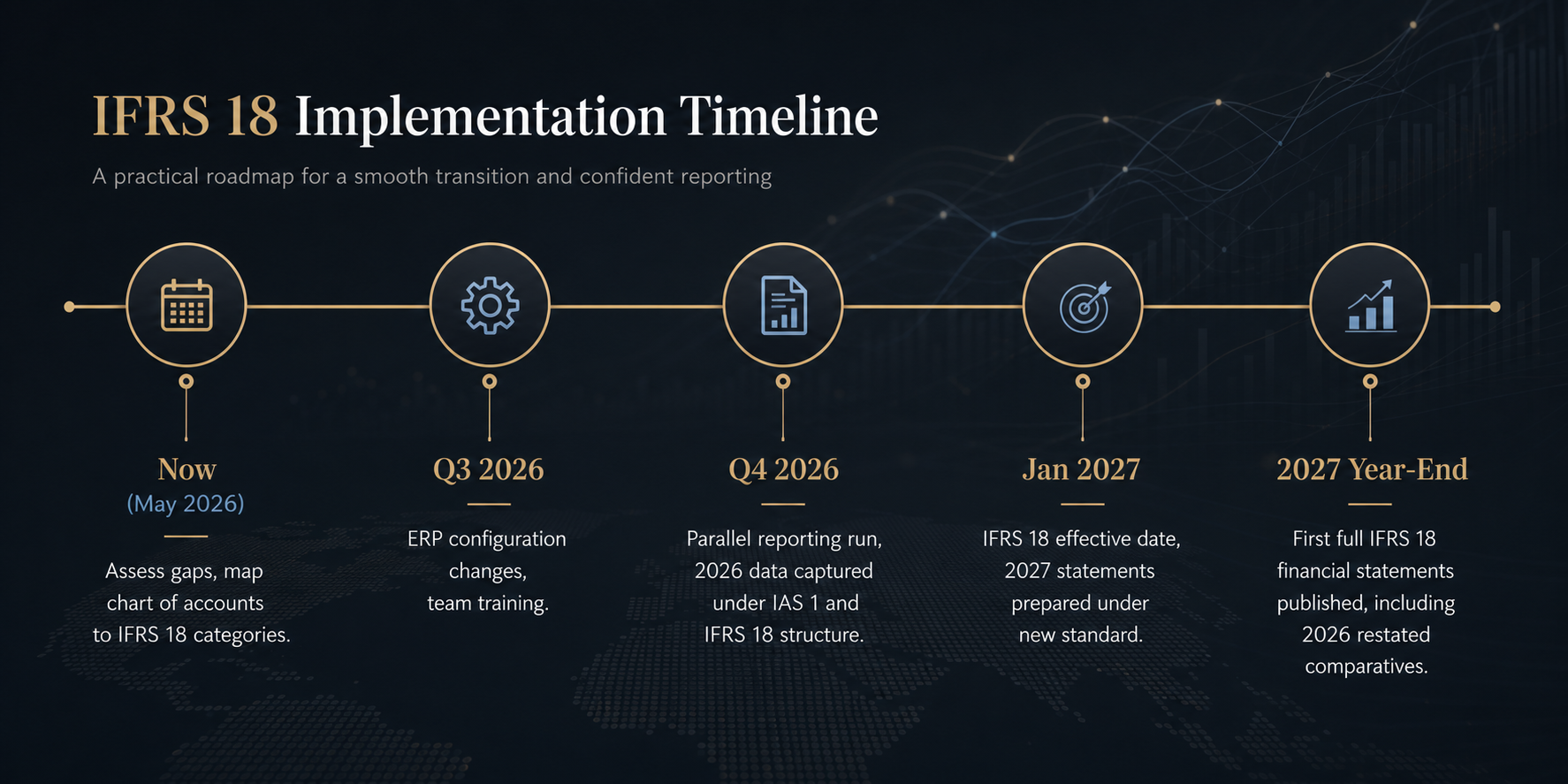
Most mid-market finance teams in the UAE are running month-end under IAS 1 and have not mapped their chart of accounts to the new IFRS 18 category structure. The time to do that is now - not in Q4 2026 when audit preparation is already underway.
The real work is not changing a heading in the financial statements. The real work is classification logic, comparative data, report configuration and governance over the performance measures management already uses in board packs, lender reporting and investor updates.
IFRS 19 - The Relief for Qualifying Subsidiaries
IFRS 19, Subsidiaries without Public Accountability: Disclosures, is also effective from 1 January 2027. It allows eligible non-listed subsidiaries whose parent produces public IFRS consolidated statements to apply reduced disclosure requirements.
This is meaningful for UAE holding structures and subsidiary companies that report under IFRS but are not themselves publicly listed. It does not remove the need to apply IFRS measurement and recognition rules, but it can reduce disclosure burden where the eligibility conditions are met.
IFRS 19 eligibility check
You may qualify for IFRS 19 relief if:
What Finance Teams Need to Do Now
The AI Angle - How Automation Helps with IFRS 18 Transition
The IFRS 18 transition has three workstreams where AI and automation genuinely reduce effort. The first is chart of accounts mapping. AI tools can classify thousands of GL codes against the new IFRS 18 category definitions in hours, not weeks. Manual mapping of large, multi-entity CoA structures is usually the biggest time sink in the transition.
The second is MPM identification and reconciliation. AI can scan financial statement disclosures, board packs and management commentary to identify alternative performance measures currently in use, flag gaps in reconciliation and draft the required disclosure text for finance review.
The third is comparative data preparation. For entities running on Odoo, SAP or Microsoft Dynamics, AI-assisted data transformation can restructure historical transaction data to align with new presentation requirements without relying on manual journal reclassifications.
I have been using AI tooling in our finance engagements for two years now. The IFRS 18 transition is exactly the kind of structured, data-heavy problem that AI handles well - provided the human judgment on classification decisions stays with the finance team. The technology handles volume; the accountant handles judgment.
IFRS 18 is the kind of change that rewards early movers and punishes the ones who treat it as a Q4 problem. The income statement your board has been reading for the last decade is about to look different. The question is whether your finance team controls that change - or is surprised by it.
Umer Nawaz FCCA
Chartered Accountant with expertise in IFRS, UAE Corporate Tax and AI-augmented Finance | LinkedIn: /omernawaz